hippocampOS

Private AI memory that remembers your work. Not just your chats.

hippocampOS builds a private AI memory graph from your email, meetings, notes, and files. One brain for each role in your life. Call one by name inside Claude or ChatGPT and the right context arrives.

Protected in transit. Google user data is not used to train generalized AI models. Deletion follows our published Privacy Statement.

What re-explaining yourself actually costs

I pay per token

Claude Code, Cursor, and API users

About 25 minutes a day.

Large context re-feeds consume input budget before you ask your real question. hippocampOS retrieves only the relevant slice, so projects stop sending their full background again and again. Retrieval runs on vector search alone. No LLM call in the path.
I pay a subscription

Claude Pro, Max, and ChatGPT Plus subscribers

Your cap dies by 2pm.

You don't pay per token, so the cost shows up somewhere else: slower answers and a usage cap that dies by 2pm. A focused memory slice instead of a re-read inbox keeps responses fast and your limits alive through the evening. And your brains are sealed. Client work never shows up in your personal chats.

I run a team.

Your company re-explains itself in every employee's every chat. A shared brain means the whole team starts from the same context, on the AI plans they already have. See what that looks like for teams.

See how your work becomes useful memory.

Your life doesn't fit in a context window.

Connect the sources you already live in. Every useful detail becomes part of a memory that keeps compounding instead of vanishing when the chat ends.

GmailNotionGranolaFiles

Not a folder. A living graph.

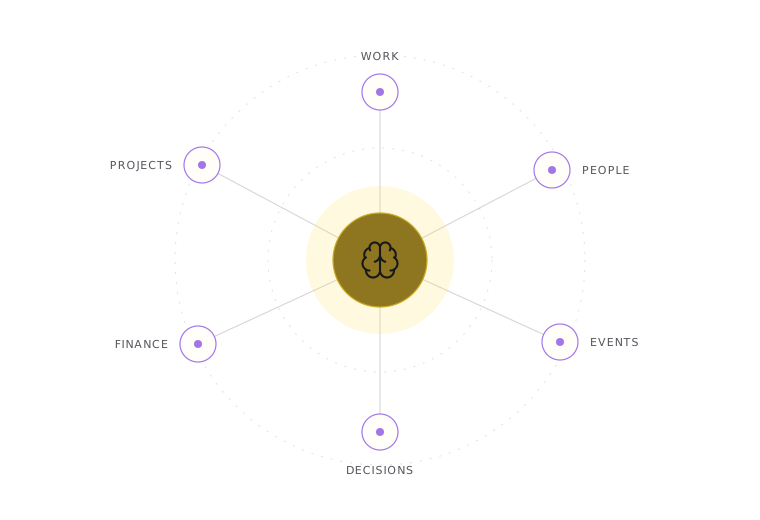
People connect to projects. Decisions connect to meetings. Facts connect back to evidence. Your memory becomes something you can traverse, not another archive you have to search alone.

Ask once. It already knows the rest.

Invoke a named brain from Claude or ChatGPT. hippocampOS finds the relevant context, carries it into the conversation, and keeps every role of your life in the right scope.

“Invoke my Work brain. What changed since last week?”

The longer it lives with you, the more useful it becomes.

No more starting from zero.

Everything your AI is missing.Connected.

Collect context once, organize it into durable memory, and bring the right part into every conversation.

01

Memory beyond the chat

Your context keeps compounding across conversations instead of disappearing when a window closes.

02

AI that learns your world

Bring the right slice of your projects, people, preferences, and history into Claude or ChatGPT when you ask.

03

A graph you can explore

See topics expand into facts and the raw sources behind them. Context stays connected and inspectable.

04

A brain for every role

Keep work, personal life, research, and client context distinct. See the whole picture in Master Brain.

05

Grounded in your sources

Facts retain their provenance, so you can move from an answer back to the material that supports it.

06

Private by design

Choose what enters each brain, what your AI can retrieve, and what should be removed.

From source to fact. From fact to understanding.

Open any category, travel into its facts, and inspect the raw sources underneath. The graph makes your AI's context tangible.

Explore your own graph

AI can know you better without knowing everything.

Named brains keep contexts separate. Retrieval brings only the useful slice. Sources and memories stay inspectable and removable.

Private by design Relevant retrieval Source provenance

Choose how muchcontext to keep.

Every plan includes every connector. No usage tiers, no surprises.

7-day, 100% refund guaranteePay today. Full refund within 7 days.Refund policy

Spark

$5/month

Billed annually at $60/yr

For one role, done well.

1 brain. 
Core connectors.
Nightly sync. 
Works with Claude and ChatGPT.
Start with Spark

Synapse

$9/month

Billed annually at $108/yr

Keep work and life separate

2 brains. 
All connectors. 
On-demand sync.
Email support.
Start with Synapse

Cortex

$19/month

Billed annually at $228/yr

For the true multi-hat operator

5 brains, plus Master Brain: one view across everything you are.
Start with Cortex
Running a team? See Corpus and Cerebrum.

Annual plans show their monthly equivalent and are billed once per year. Your AI provider remains separate; hippocampOS provides the memory layer.

Questions worthanswering directly.

The short version of how hippocampOS works, what it remembers, and where its boundaries are.

01

What is hippocampOS?

hippocampOS is a private AI memory layer for people and teams who use Claude, ChatGPT, and compatible MCP clients. It organizes authorized email, meeting notes, documents, and files into named brains, then retrieves a focused, source-linked slice when a user asks for that context.

02

How is hippocampOS different from Claude or ChatGPT memory?

Claude and ChatGPT memory retain context inside their own products. hippocampOS keeps a separate, source-linked memory graph built from the work systems you authorize. It complements provider memory by carrying selected context across compatible AI clients instead of replacing their native memory features.

03

Which sources can hippocampOS remember?

hippocampOS can build memory from supported sources including Gmail, Notion, Granola, meeting records, and files you choose to connect or import. Source material stays linked to the memory it supports so you can inspect where a remembered fact came from.

04

How does hippocampOS work with Claude and ChatGPT?

hippocampOS connects to supported AI clients through the Model Context Protocol, or MCP. After authorization, the client can list the brains you can access and retrieve bounded context from a selected brain. The public MCP surface is read-only: it does not let the AI edit your stored memory.

05

How does hippocampOS keep different parts of my life separate?

You create named brains for durable roles such as work, a client, research, or home. Each brain is an intentional memory boundary, so a request using one brain retrieves context from that scope instead of automatically mixing material from every connected source.

06

Does hippocampOS use an AI model for every memory search?

No. The retrieval path uses vector search to select a compact, relevant slice of stored context without making an LLM call. The selected context can then be used by Claude, ChatGPT, or another compatible client to answer the user's request.

Your AI meets the version of you who remembers.

Build the context layer that gets more useful every time you use it.

Start building